Purchasing packaging equipment represents a massive operational investment for any growing business. Choosing the wrong setup quickly leads to packaging bottlenecks. It can cause compromised seal integrity. Poor choices also trigger frustrating daily disruptions. Buyers often misunderstand the huge gap between basic consumer models and true industrial-grade equipment. Commercial facilities demand relentless performance. They require strict atmospheric controls and specialized hygiene compliance. You cannot rely on trial and error when product shelf life is on the line. We will provide a structured evaluation framework to guide your decision. You will learn how to accurately match machine capacity to your daily production volumes. We will show you how specific physical product properties shape your equipment needs. Finally, you will discover exactly what technical specifications matter most. This guide empowers you to confidently shortlist the best equipment for your facility.
Key Takeaways
Align machine capacity with actual daily production volumes, not just peak estimates, to ensure optimal ROI.
Product characteristics—specifically moisture content and dimensions—dictate whether a chamber, external, or vertical design is required.
Pump type (oil-lubricated vs. dry) determines continuous operating capability and maintenance requirements.
Evaluating a vendor's after-sales support and spare parts availability is as critical as assessing the machine's technical specifications.
Defining Your Operational Baseline and Success Criteria
Every successful equipment purchase begins by establishing a clear operational baseline. You must define exactly what your production line demands daily. Vague estimates often lead to poor purchasing decisions. We recommend building a robust criteria profile before you even contact a supplier.
Calculate Throughput Requirements
You need to establish precise baseline metrics to find the right equipment. Calculate your required cycles per minute and map this against anticipated growth. A standard Vacuum Packing Machine handles a specific number of pouches per cycle. To find your true throughput, multiply the pouches per cycle by the cycles per hour.
Avoid under-speccing your equipment. Pushing a small machine beyond its limits strains internal motors and burns out heat sealers. Conversely, over-speccing ties up critical capital. You do not need an industrial multi-chamber machine if you only pack fifty items daily. Map your current volume, add a twenty percent growth buffer, and target machines hitting that specific sweet spot.
Analyze Product Characteristics
Your product dictates the specific technology you need. Different items react uniquely to atmospheric pressure changes.
Solids vs. Liquids and Marinades: Sealing solid items like dry aged steaks is straightforward. Liquids pose a massive challenge. When atmospheric pressure drops inside a vacuum chamber, the boiling point of liquids plummets. Cold soups can suddenly boil over. Identify if your product requires specialized pressure management systems to prevent this messy phenomenon.
Size and Footprint: You must map your maximum product dimensions. Compare these measurements directly to internal chamber sizes. Ensure you leave adequate clearance around the product for the bag opening. Furthermore, evaluate your facility floor plan. Countertop space is often limited in commercial kitchens. Measure your available footprint before reviewing equipment spec sheets.
Hygiene and Compliance
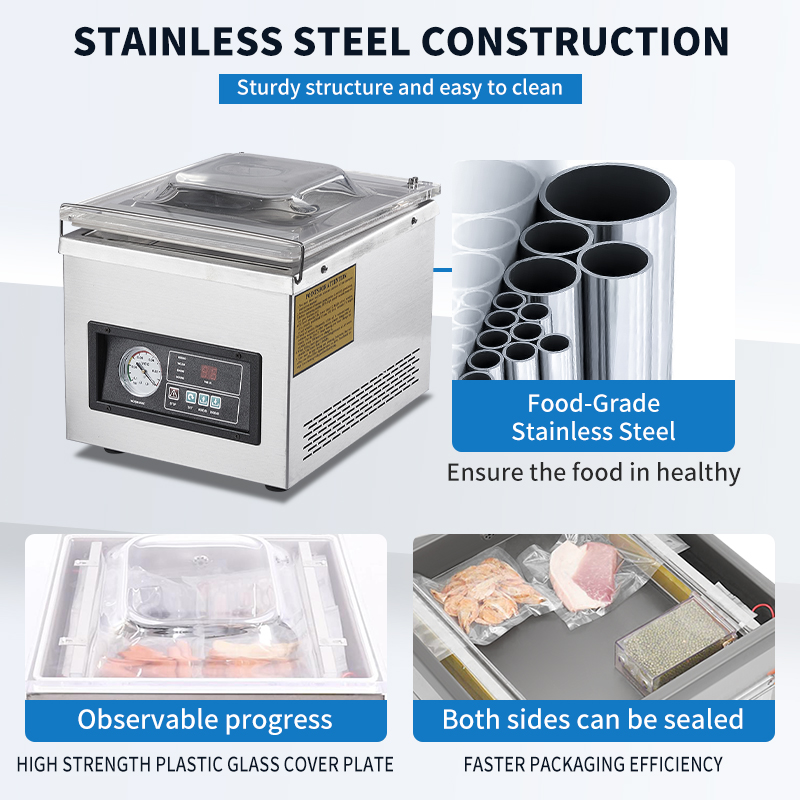
Sanitary requirements vary wildly across different industries. Food processing plants operate under strict regulatory scrutiny. Meat packing facilities require robust washdown capabilities. Look for IP65 waterproof ratings. This rating ensures the machine withstands low-pressure water jets during end-of-shift cleaning. You should also demand 304 or 316 stainless steel construction. These materials resist harsh sanitizing chemicals and prevent rust buildup over time. Never compromise on hygiene compliance, as failed health inspections halt production entirely.
Evaluating the Main Categories of Vacuum Packing Machines
Manufacturers engineer different machine architectures to solve specific packaging problems. Understanding these structural differences prevents costly mismatched applications. Let us explore the three primary equipment categories available today.
External Sealer (Edge Sealers)
External sealers represent the simplest approach to vacuum packaging. The bag remains outside the machine. A specialized nozzle or channel extracts air directly from the bag opening before heat sealing it closed.
These machines are best for low-volume production. They handle dry products exceptionally well. They also accommodate oversized items. If you need to package whole large fish or long racks of ribs, external sealers offer unmatched size flexibility. However, they carry severe limitations. They are highly inefficient for liquids. The suction mechanism often pulls marinades directly into the seal area, ruining the closure. Furthermore, external models overheat easily under continuous commercial use.
Chamber Machines (Tabletop and Floor Models)
Chamber machines operate on a fundamentally different physics principle. You place the entire product and pouch inside a sealed box. The machine evacuates air from the entire enclosed space simultaneously.
These models are best for medium to high-volume commercial kitchens. They dominate liquid-rich food packaging applications. They deliver consistent, repeatable vacuum pressure on every cycle. Their technical edge lies in pressure equalization. Because the pressure drops equally inside and outside the pouch, liquids remain completely stationary. Marinades never get sucked into the seal bar. This guarantees a secure, leak-proof package.
Vertical Vacuum Machines
Vertical machines flip the traditional orientation ninety degrees. The bag stands upright during the entire extraction and sealing process.
They are best for bulk flowable goods. Roasters use them for coffee beans. Agricultural processors use them for grains and powders. Heavy industrial products also benefit from this design. The primary advantage is gravity. Gravity assists with loading the product into the pouch. It also helps settle flowable items into a dense, uniform brick shape. This shaping capability makes vertical machines invaluable for maximizing shipping crate density.
Category Comparison Summary
| Machine Category | Ideal Applications | Primary Technical Advantage | Notable Limitation |
|---|
| External Sealer | Oversized items, dry goods, low-volume runs | Unlimited product length flexibility | Cannot handle liquids; overheats under heavy use |
| Chamber Machine | Liquids, marinades, commercial food processing | Pressure equalization prevents liquid pull | Product size constrained by internal chamber dimensions |
| Vertical Machine | Grains, powders, coffee beans, flowable solids | Gravity-assisted dense brick shaping | Requires specialized vertical feeding infrastructure |
Core Technical Specifications That Drive Performance
Beyond structural categories, internal components dictate real-world performance. You must scrutinize the technical specifications to ensure the machine survives your production environment. Let us examine the vital internal systems.
Vacuum Pump Architecture (Dry vs. Oil-Lubricated)
The vacuum pump acts as the heart of your machine. You essentially choose between two distinct pump engineering styles.
Dry pumps require virtually zero routine maintenance. They utilize self-lubricating graphite vanes. They are highly suitable for intermittent daily use. If you run a small deli, a dry pump offers excellent convenience. However, they generate significant heat. You must allow them to cool between intensive cycles.
Oil-lubricated pumps power serious commercial operations. They pull air faster and achieve deeper vacuum levels. They handle continuous, heavy-duty shifts without overheating. You must acknowledge the reality of mandatory maintenance schedules. Operators must perform regular oil changes and visual inspections. Clean oil maintains peak suction power. Neglecting oil maintenance destroys the pump entirely.
Seal Bar Configuration and Width
The seal bar determines your actual production speed. You must assess single versus double seal bar layouts. A machine equipped with two seal bars doubles your output per cycle.
You must calculate how many pouches fit onto a single bar. Use this simple calculation framework:
Measure your seal bar total length (e.g., 400mm).
Measure your standard pouch width (e.g., 120mm).
Add a spacing buffer between pouches (e.g., 10mm).
Divide the bar length by the pouch width plus buffer.
In this scenario, you fit three pouches per bar. Double seal bars yield six pouches per cycle. This calculation reveals your true throughput capability.
Gas Flush Capabilities (MAP)
Modified Atmosphere Packaging radically alters shelf life. Many advanced machines include gas flush capabilities. You must evaluate if your product requires this specific intervention.
The machine extracts ambient air and instantly injects a specific gas mixture before sealing. Nitrogen injection protects fragile items like potato chips from crushing. It creates a protective cushion. Carbon dioxide and oxygen blends preserve fresh meat color. These gas mixtures prevent enzymatic browning. If you process delicate or easily discolored products, MAP capabilities are absolutely non-negotiable.
When to Upgrade to an Automatic Vacuum Packaging Machine
Manual operations eventually hit a rigid productivity ceiling. Recognizing this threshold prevents stalled business growth. Upgrading to automated systems transforms your production floor.
Identifying the Tipping Point
You must identify when manual labor becomes inefficient. Tabletop chamber machines require operators to individually load, position, and remove every single pouch. This repetitive motion consumes vast labor hours. The tipping point arrives when labor costs eclipse equipment financing costs. If you run multiple shifts just to meet packaging quotas, manual machines are holding you back. Transitioning to an Automatic Vacuum Packaging Machine drastically slashes per-unit labor requirements.
Inline Integration
Automation unlocks powerful inline integration. Fully automatic systems do not operate in isolation. They connect directly to your broader factory ecosystem.
You can synchronize an automatic machine with existing conveyor systems. Products flow seamlessly from prep stations directly into the packaging zone. You can also integrate them with automated volumetric fillers. Liquid pumps dose precise soup portions into pouches immediately before the automatic vacuum cycle engages. Thermoforming lines take this further, creating the pouch from raw film, filling it, and vacuum sealing it in one continuous robotic motion. This integration eliminates human touchpoints entirely.
ROI Considerations
Automated equipment demands higher upfront capital expenditure. However, you must weigh this against immense productivity gains. Automatic systems deliver drastically faster cycle times. They operate at speeds human hands cannot match. They also guarantee standardized packaging consistency. Every seal is identical. Every vacuum depth is exact. This consistency reduces product rejection rates. By reallocating packaging staff to higher-value processing tasks, your overall facility output multiplies. The return on investment manifests through pure volume expansion and error reduction.
Vendor Evaluation and Procurement Standards
Procuring industrial equipment involves significant operational risk. You are not just buying metal and motors. You are entering a long-term partnership with a manufacturer. Rigorous vendor vetting prevents catastrophic production downtime.
Supplier Vetting for B2B Procurement
Your B2B procurement strategy must look beyond the initial sales pitch. Begin by verifying factory certifications. Demand proof of CE, UL, or ISO compliance. These documents validate their engineering safety standards.
Assess their OEM and customization capabilities. Off-the-shelf machines rarely fit complex processing lines perfectly. A strong manufacturer can customize seal bar lengths, integrate specialized gas flush valves, or modify voltage requirements. If you purchase directly from overseas manufacturers, clarify their minimum order quantities (MOQ). Some factories refuse single-unit sample orders, which complicates pilot testing.
Warranty Terms and Replacement Parts
Equipment breaks. Seals degrade. Heat wires snap. Your vendor's response time dictates your downtime. You must aggressively evaluate their warranty terms. Determine exactly what components fall under warranty protection. Labor is often excluded.
More importantly, investigate their guaranteed availability of replacement parts. Ask where they warehouse their spares. If a simple Teflon strip ships from a different continent, your production line halts for weeks. Reliable vendors maintain domestic distribution hubs for critical components. Prioritize suppliers who guarantee rapid parts dispatch to secure your daily operations.
Conclusion
The optimal vacuum packaging strategy perfectly balances your immediate product requirements with scalable production capacity. You must respect the physical properties of your food or industrial goods. Liquids demand chamber equalization, while fragile items require precise gas flushing. Moving from manual models to automated inline systems unlocks tremendous facility output and standardized quality.
Your next step is critical. Never finalize a purchase order based solely on brochures. Request a physical sample test. Send your specific product and preferred pouch material to the manufacturer. Ask them to run live cycles and return the sealed samples. Inspect the seal integrity, check for liquid pull, and verify the vacuum depth. This practical validation ensures your chosen equipment performs exactly as promised on your production floor.
FAQ
Q: Can a standard vacuum packing machine seal liquids?
A: External edge sealers handle liquids very poorly. Their suction pulls marinades and soups directly into the seal area, causing leaks. Chamber machines handle liquids perfectly. They equalize pressure inside and outside the pouch, keeping liquids completely stationary during the air extraction process.
Q: How often does an oil-lubricated vacuum pump need maintenance?
A: Maintenance schedules depend entirely on usage intensity. Generally, you must change the pump oil every 200 to 250 operating hours. You should perform a visual oil inspection weekly. If the oil looks cloudy, white, or dark, change it immediately to protect the motor's longevity.
Q: What is the difference between a tabletop and a freestanding chamber machine?
A: Tabletop models feature smaller internal pumps and shorter seal bars, designed for lower-volume countertop use. Freestanding floor models house massive, heavy-duty pumps. They offer significantly longer seal bars, larger chamber depths, and endure continuous high-volume shifts without overheating.